

Record Ridge: Now we wait for the judge's decision

By Sara Golling
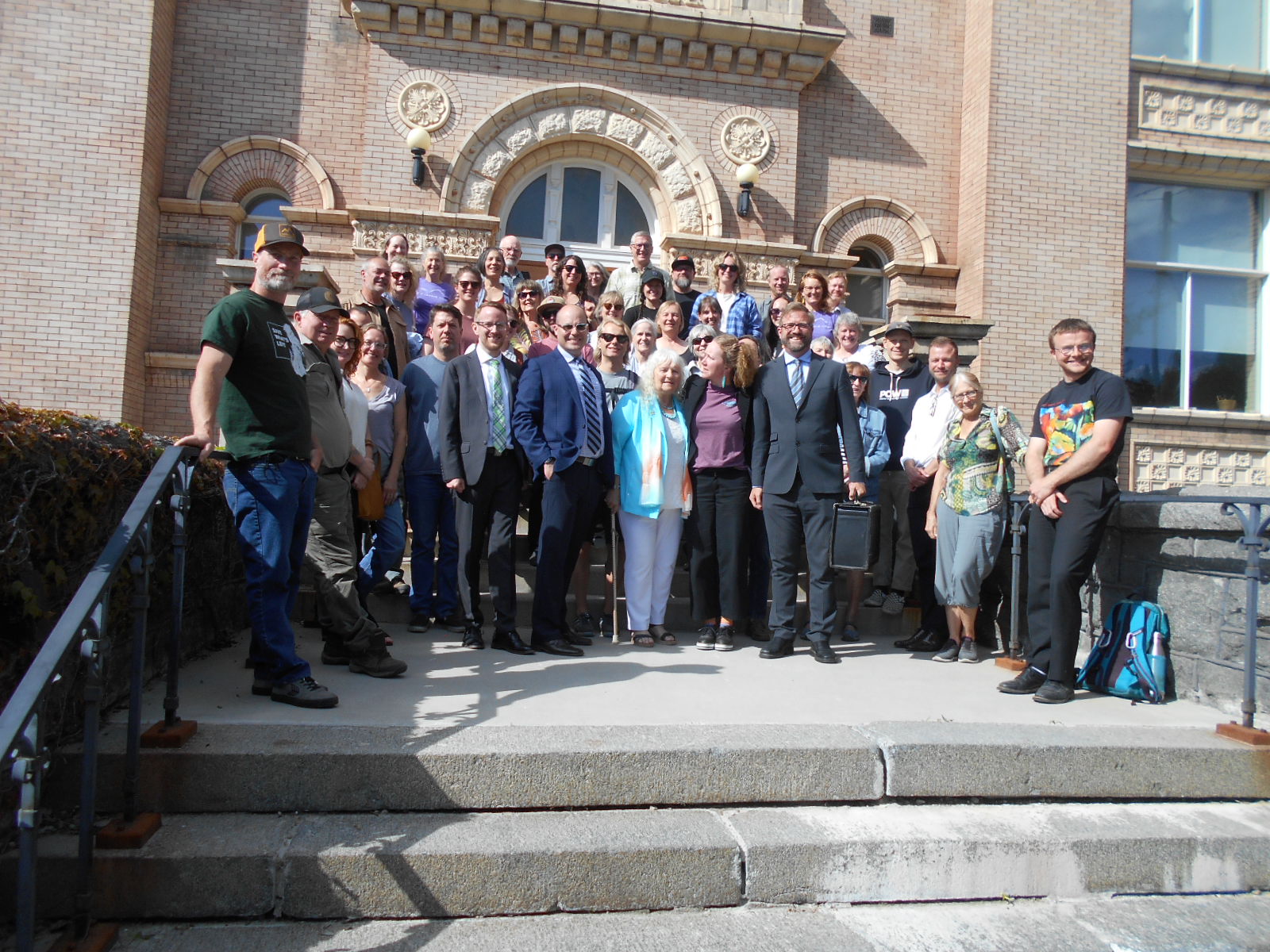
The court hearing on the issue of whether or not the Environmental Assessment Office’s (EAO) decision not to order an environmental review, or assessment (EA) of the proposed Record Ridge open-pit mine was reasonable was held in the Rossland courthouse from May 5 to May 7 inclusive, before Justice Gordon C. Weatherill. Four parties were represented by counsel: the Save Record Ridge Action Committee (SRRAC), the Sinixt Confederacy, the BC Government, and West High Yield (WHY). Local residents and officials interested in the case and its outcome attended in numbers that required the balcony seating to be opened.
There was some initial quibbling about the participation of the Sinixt whom WHY’s counsel characterized as “an American Tribe”, perhaps not having read the Supreme Court of Canada case confirming that the Sinixt are an aboriginal people of BC.
Counsel for the various parties discussed at some length the definitions of an “eligible project” and “production capacity” and referred to previous case law on the judicial review of EAO decisions on whether or not a project should be subject to an EA.
SRRAC pointed out that WHY had changed the amount of ore it planned to produce from Record Ridge from an initial announcement of 249,000 tonnes annually, to 200,000 tonnes annually, to a final modest amount of 63,500 tonnes annually, and each time, it was changed in order to avoid any requirement for an EA.
SRRAC also pointed out that the size of the planned work on the ground did not shrink along with the production plans; and that WHY could avoid an EA no matter how large its operation grew by simply building the “footprint” of the operation — the infrastructure — large enough at the beginning to handle expansion, because in the event that WHY greatly expanded its production, no EA would be required unless the “footprint” of the operation grew by over 50%. SRRAC referred to this as “the loop-hole” by which WHY could make its operation far larger than would normally trigger a requirement for an EA.
WHY argued that there was not really any “loop-hole” and that any ideas about future production were nothing more than speculation; SRRAC pointed out the many declarations by WHY on its website and in investor publications of its intention to greatly expand production for an extended period — decades.
The government lawyer expounded on a number of points, until Justice Weatherill finally asked him, “if you’re not here to defend the reasonableness of the EAO’s decision, why are you here?” The government lawyer stated that the EAO decision was not a decision, but an opinion; that the EAO does not make decisions. Justice Weatherill summed it up: “The minister cannot decide, but can decide to designate a project.”
The government lawyer also listed a number of documents that he stated should not be “on the record” because although the ministry staff saw them, he said the Minister did not see them, therefore they should not be considered as “on the record.” He then revealed what his client wants: for the court to either find that the EAO was reasonable, or to remit the matter back to the EAO for re-consideration.
WHY’s lawyer spoke for most of Thursday, in the course of which she denied that there was any loop-hole, pointed out that WHY has been up-front about its desire to avoid an EA because of the cost and delay, asserted that WHY has already been working toward this mine for over 20 years now and has spent over 53 million dollars doing so, and has consulted with affected first nations for two years (some heads were shaking among the audience and at the counsel tables when she said that), and has hosted public consultations (for anyone who missed those public meetings in May of 2023, click this link for an article describing them. They were fairly lively.) WHY’s lawyer urged “judicial restraint” and said that “great deference” is owed to administrative decision-makers.
She also tried to persuade the judge to terminate the injunction that keeps WHY from beginning construction of the mine until after determination of this issue. Justice Weatherill pointed out that the order imposing the injunction states how long it will remain in effect, and that, in any case, WHY does not yet have all the permits it needs to commence construction.
Justice Weatherill said that he will probably have his decision completed by mid-June.