
The Trail Regional Airport: A legacy of volunteerism

By Andrew Bennett
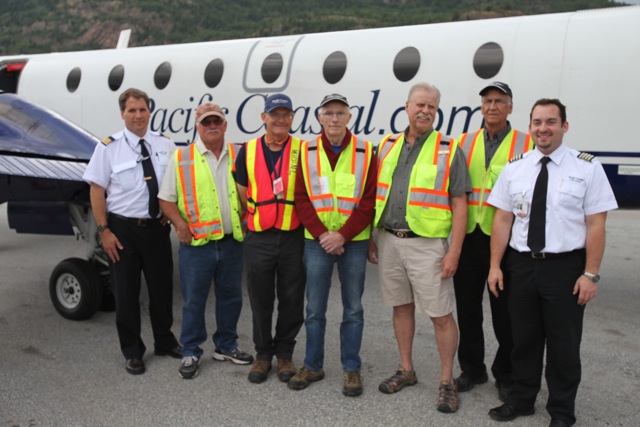
The Trail Regional Airport (TRA) is fundamental to affordable and reliable air transportation in the Lower Columbia, and that is central to the area’s economic prospects, argued the airport’s chief volunteer Don Nutini and Mike Martin, the chair of the LCCDT—Lower Columbia Community Development Team—in recent interviews with the Rossland Telegraph.
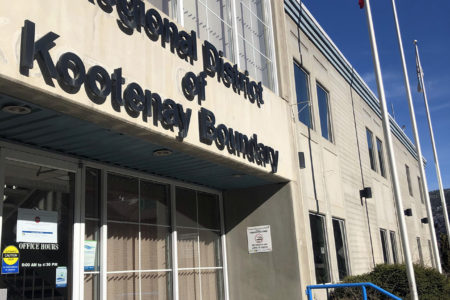
TRA is owned and managed by the Regional District of Kootenay Boundary (RDKB) and is operated by six dedicated and certified volunteers, all of them retirees between the ages of 66 and 81 who each put in roughly 1000 hours of work per year.
Besides Nutini, the other five volunteers are Brent Lee, Neil Craig, Al Doherty, Michael Whitehead, and Gordon Cook.
Nutini, who Martin describes as the “forefather and founder,” has been at the helm since TRA became a commercial airport in 2003. He schedules the volunteers and makes sure that all the Transport Canada regulations are fulfilled.
From about 7am to 7pm each day, at least one volunteer is at the airport making sure the runway is in good enough condition to land, doing friction tests each morning and before each flight, shooing away the birds, checking and rechecking the weather patterns and instrumentation, communicating with the airline, coordinating with the snow plough operator—the airport’s only paid employee—and “all the necessary things to keep the airport operating safely,” Nutini said.
In winter, of course, it’s more difficult, and on any particular day the lead volunteer may have to call in one or two other volunteers from the group to help with extra tasks that crop up under adverse conditions.
Martin said these volunteers “amaze” him and have consistently gone “above and beyond the call of duty.”
As a result of approximately 6000 unpaid hours of skilled work each year—more than 400 hours per month through the warm months, and more than 550 per month through the cold ones—the airport only costs the RDKB about $160,000 per year to operate.
“Per household [in the RDKB], that’s something like $3 per $100,000 of assessed value,” Nutini said. Put another way, the airport costs roughly $6 to $8 per passenger who flies in or out of TRA.
Pacific Coastal (PC), the primary airline besides charters that has used the TRA for the past six years, supplies the personnel at the check-in and ticket booth. Each day PC sends two 19-seat flights to Vancouver, one in the morning and one right after lunch, and now they fly a 30-seat flight to Vancouver at 6 p.m. as well.
But what drives these six volunteers to put in so much effort? Most airports are run by salaried workers and, to our knowledge, there are no other examples of a volunteer-run commercial airport in Canada’s south.
“It’s dear to our hearts,” Nutini said, “We’re six people that just love doing it. When you like doing what you’re doing, it’s no problem. It’s satisfying to give back to community. The community has indicated that [the TRA] is what they’d like to see done, to revitalize it and run it as well as it’s doing. And we’ve proven that. We’re working towards 28,000 to 30,000 passengers this year, up from 20,600 in 2011.”
Martin explained that the LCCDT, a volunteer society founded in 2001 to stimulate economic activity in the Lower Columbia, initiated the TRA for two main reasons: “One was to provide reliable air service to the region. We established a goal of achieving 98 per cent reliability on flights in and out of region,” he said, acknowledging that “winter months are the difficulty.”
Although winter conditions prevent TRA from reaching this lofty goal, data back to 2008 shows reliability above 81 per cent, and in 2011 reliability was 94 per cent on average. Now, during summer months, reliability is above 98 per cent. For details, see pages 12 and 13 in the Lower Columbia Initiative’s 2012 Economic Outlook report, attached below.
“It’s all weather related,” explained Nutini, who is also the past chair and current member of the LCCDT Airport Access Committee. “We have always operated the airport the same.”
Relative to the West Kootenay Regional Airport (WKRA) in Castlegar, however, “we’ve always been between 12 and 25 per cent better for landings at this airport,” he said.
“The second goal of the TRA,” Martin said, “was to enhance the affordability of air transportation in the region.” Although lacking data to prove it, “on a personal basis,” he said, “air transport in the region is far more reasonable than it was 10 years ago, and that has come about with the competition provided by the two airlines serving the region. That’s my belief.”
Nutini was clear, “Without the [TRA], we’d still be paying $650 or $700 to fly to Vancouver.”
Today, the lowest fare offered by PC is $104 plus tax, he continued, “and our fees are not as much as at most airports. Pacific Coastal itself has fewer fees, and we don’t have any ‘upgrade’ fees like many other airports.”
Martin said, “Pacific Coastal operates in a niche market, so we do not see this as competition [with WKRA].” He also clarified that Castlegar is outside of the Lower Columbia area, so does not fall within the LCCDT’s mandate.
He said the LCCDT’s driving question is, “How do we provide reliable, affordable, air access to the region? This could well include Castlegar regional airport. Good air access is foundational to economic development, whether supporting industry, or supporting tourism, it’s an important element to get people in and out of here.”
Martin spoke in favour of “synergy” between the region’s airports. “I don’t see it as us or them. It’s not one or the other,” he said. “It’s really important that we work together in a partnership to provide improved and affordable air access. If we can work as partners in this initiative, that will bring some true strength to our region. That is, after all, what we want to accomplish here.”
Martin gave the new 6pm PC flight as an example. “What that has done, from a business perspective, is improved the productivity of the work day. It has extended the period in either Trail or Vancouver for work activity, as opposed to staying overnight or those sorts of inconveniences. Again, I have no hard data to prove that, but there has to be some improved productivity, especially with two big projects in our region right now.”
He was referring to the Waneta expansion and major new construction at Teck. “It’s a short term, two to five year window,” he said, “but a great window on which to build this airport.”
Martin continued, “We’ve demonstrated a solid need for this air service. Now it needs to be taken to the next step.”
“We can land most aircraft,” Nutini said, noting that the RDKB five year plan “indicates paving the stop and runouts. It’s already being engineered and prepared for large aircraft.”
Martin further explained that the RDKB airport master plan—attached below—gives a “roadmap” to “establish a business case for further investments in that airport. It lays out the various needs for this airport if, in fact, it is going to move forward and become a sustainable long term service to the community. That includes a terminal building, a marketing plan, and to lengthen the runway. But nothing is going to happen on that roadmap until the RDKB’s economic impact assessment is completed some time in August.”
Nutini also sees the Kootenay Boundary Regional Hospital and TRA as “closely linked,” because most fixed-wing medivacs come in and out of TRA and have done so since the airport was just a flying club. Nutini currently chairs the LCCDT Health and Hospital Committee, but his involvement in health care includes 60 years with St John’s ambulance, a director on the hospital board in Trail from 1977 to 1992—including six years as chair—and a member of the Trail Regional Hospital Foundation from 1988 to 2001.
Nutini is proud of the TRA’s history, which goes back to 1920 when the Consolidated Mining and Smelting company used it, about a decade before Nutini was born.
He is also proud to serve his community. He spent 41 years with Cominco and Teck, starting in the trades and ending as a project manager and industrial engineer, retiring in 1991 and working as a consultant until 1999. Nutini and his wife Lorna have 7 children and 14 grandchildren. Look for Nutini on the slopes of Red Mountain 40 days a year—it would be more, he said, except for his annual month’s vacation in Hawaii.
“We have to give back a lot,” Nutini said. “We got a lot from Trail, and from the company. It gave us a good living and still does.”
“My hope,” Martin said, “would be for some continuous and strong support from the communities for this group of volunteers who are absolutely committed to the sustainability and growth of our communities. My one wish is that we all recognize and support that. There’s such a tremendous opportunity for us there.”