
SRRAC defeats two court challenges by WHY after winning an injunction

By Contributor
With files from the Save Record Ridge Action Committee (SRRAC)
The first case: WHY challenged the right of the Sinixt to participate in the upcoming judicial review. Details below.
A procedural hearing was held on Tuesday, April 14 at the Rossland Courthouse ahead of a judicial review scheduled for May. That review will examine the Province’s decision not to require an environmental assessment for the proposed Record Ridge mine.
The matter involves West High Yield Resources, a Calgary-based junior mining company, and the Save Record Ridge Action Committee (SRRAC), a local public interest group representing residents and business owners in the Rossland area. The Sinixt peoples, whose ancestral territory includes the Rossland area, are also seeking to participate in the judicial review.
West High Yield brought the application seeking to exclude Sinixt from participating in the upcoming judicial review.
Multiple Sinixt members were present at the hearing on Tuesday, along with staff from their office in Nelson, B.C.
Dozens of SRRAC members and supporters also attended. The courtroom was once again full, with the balcony opened to accommodate the crowd. All three directors of SRRAC were present in the court, along with legal counsel.
It appeared that representatives from West High Yield did not attend either in person or online; the company’s legal counsel appeared virtually.
Counsel for Sinixt argued that inclusion is in the interests of justice and efficiency, noting that it makes no sense to run multiple, separate proceedings on the same issue. Both Sinixt and SRRAC applied for an environmental assessment of the same project around the same time, received a single combined decision from the government, are challenging that same decision, and are seeking the same remedy: an environmental assessment of the Record Ridge open pit mine.
Counsel for Sinixt emphasized that they had made efforts to accommodate alternative approaches to their involvement, while West High Yield declined to engage on any workable solution. Counsel for both Sinixt and SRRAC also noted that West High Yield has still not filed a response to SRRAC’s petition for judicial review, now more than six months overdue.
The Province took no position on the application.
The matter was heard by Associate Judge Stephen Schwartz, who dismissed West High Yield’s application in full, finding there was no legal basis for the request and that it was unnecessary. The Court also ordered that West High Yield pay legal costs to both SRRAC and Sinixt.
“This was a clear and decisive outcome,” said Melanie Mercier, one of SRRAC’s directors. “The court rejected an unnecessary attempt to exclude Sinixt, who are seeking to be heard on the exact same issue. We were proud to stand alongside them here in the very heart of their territory, and we’re looking forward to the hearing in May.”
The ruling marks the second consecutive legal defeat for West High Yield in a matter of weeks. On March 11 a Supreme Court judge issued an injunction sought by SRRAC to stop the mine from go ing ahead until the judicial review of the Province’s decision has been heard and decided.
The second case: WHY appealed the injunction — and the BC Court of Appeal refused to hear the appeal.
The decision, delivered by Justice W. Paul Riley, means no construction, operations, or ground-disturbing activity can proceed until the judicial review is heard in Rossland in early May.
At the original injunction hearing in March, Rosslanders packed the courthouse to capacity. A similar turnout is expected when the case returns to Rossland in early May. A director of the Save Record Ridge Action Committee (SRRAC) was present for the appeal hearing in Vancouver. No representatives from W.H.Y. Resources attended.
W.H.Y. challenged the injunction from multiple angles. The company argued the judge applied the wrong legal framework, failed to properly weigh the merits of the case, mischaracterized the risk of the project becoming “substantially started,” and improperly advanced the hearing timeline. It also sought to introduce new evidence.
The Court rejected those efforts.
In his oral decision, Justice Riley found that the proposed appeal did not raise issues of broader legal significance and would not advance the underlying case. He noted that many of W.H.Y.’s arguments were highly fact-specific, entitled to deference, or unlikely to succeed.
The Court also refused to admit W.H.Y.’s new evidence, which was centred on a press release about an agreement to sell the rock extracted from Record Ridge. The press release was issued by W.H.Y. on 11 March, the same day that the injunction was first decided. The judge found that even if accepted, it would not have materially changed the outcome of the leave application. Notably, no underlying contract was placed before the Court – only the company-issued press release, submitted through an affidavit from one of its own directors.
A central issue in the case was timing. Justice Riley accepted that the injunction arose in part because W.H.Y. declined to make itself available for a hearing before August 2026, despite efforts by other parties to secure an earlier date. The chambers judge had found that accepting that position would effectively reward delay and risk rendering the case moot.
SRRAC maintains that the injunction preserves the status quo so that the Court can determine whether the project requires an environmental assessment before irreversible impacts occur.
Earlier in the regulatory process, the project was proposed as an industrial quarry with a stated production capacity of 200,000 tonnes per year. The BC Environmental Assessment Office determined that the project was a mineral mine and required an Environmental Assessment (EA). Following that determination, the proponent revised the project, reducing the stated production capacity to 63,500 tonnes per year, which is below the 75,000-tonne per year threshold that triggers an EA for a mineral mine. The revised project remains essentially the same as the original 200,000-tonne project but is being treated as no longer requiring an EA. This is the matter that SRRAC is challenging in court.
SRRAC has also filed a petition for judicial review of the project’s Mines Act permit, arguing that it was issued without sufficient baseline data on air quality, water contamination, and on the asbestos that is present in the rock; that expert evidence showing the project is overbuilt was disregarded; and that economic impacts to the tourism industry were not addressed, among other concerns.
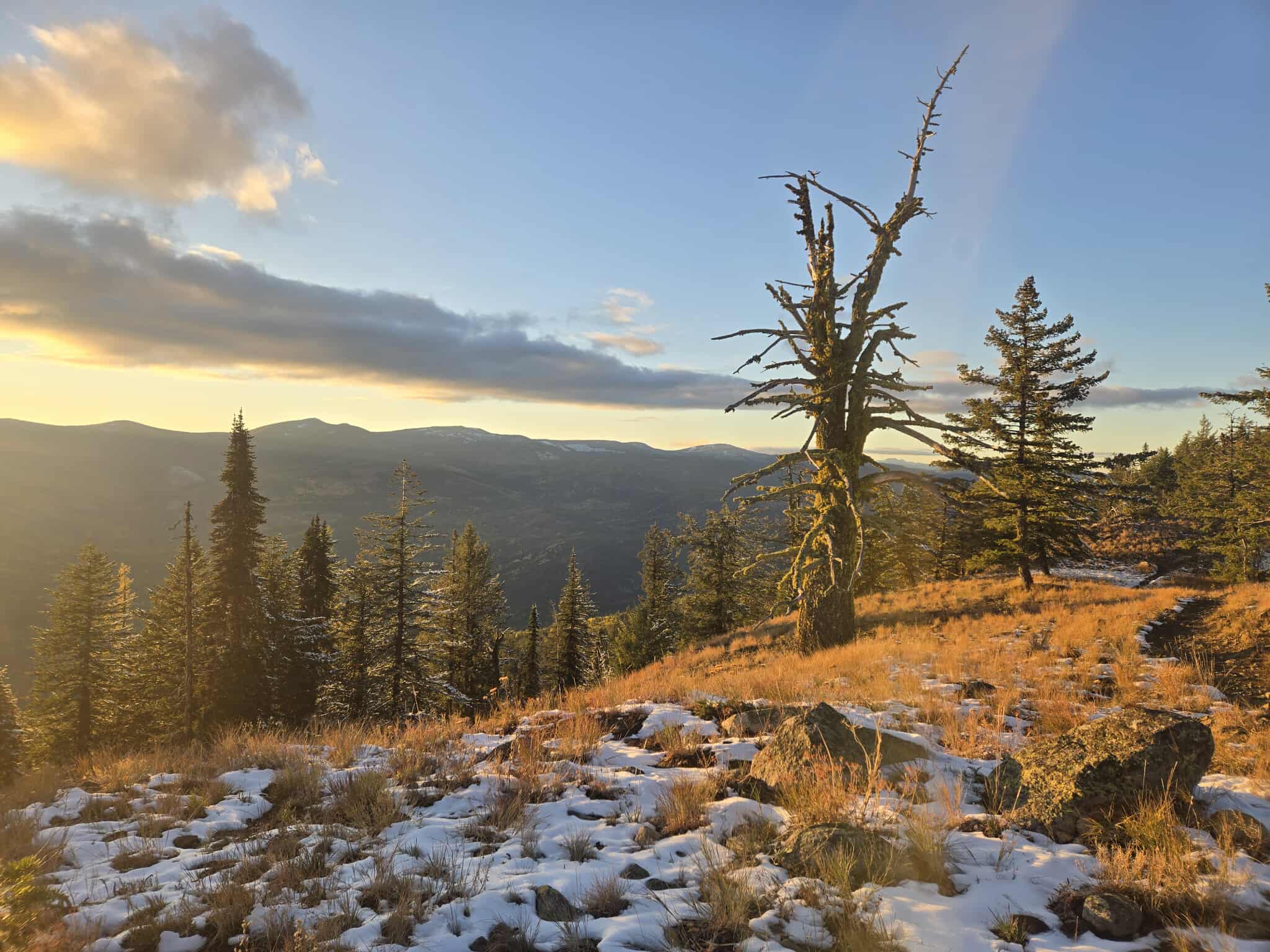
Record Ridge is located approximately seven kilometres southwest of Rossland and is a recognized BC Resort Municipality with an economy strongly dependent on outdoor recreation and tourism.
Record Ridge sits within a landscape widely used for recreation by citizens from across BC and the Pacific Northwest more broadly, with many visitors coming from Spokane, Seattle, and Portland in the US and from Kelowna and Vancouver in BC. The proposed mine would be immediately adjacent to the internationally renowned Seven Summits Trail and only a few kilometers from the boundaries of Red Mountain Resort, which attracts visitors from across BC and from around the world.
The Record Ridge area also contains multiple rare ecosystems, including alpine grasslands and old-growth forests, and is recognized internationally as a Key Biodiversity Area. Record Ridge lies within the Columbia River watershed, upstream of one of the largest salmon restoration efforts underway anywhere in North America.